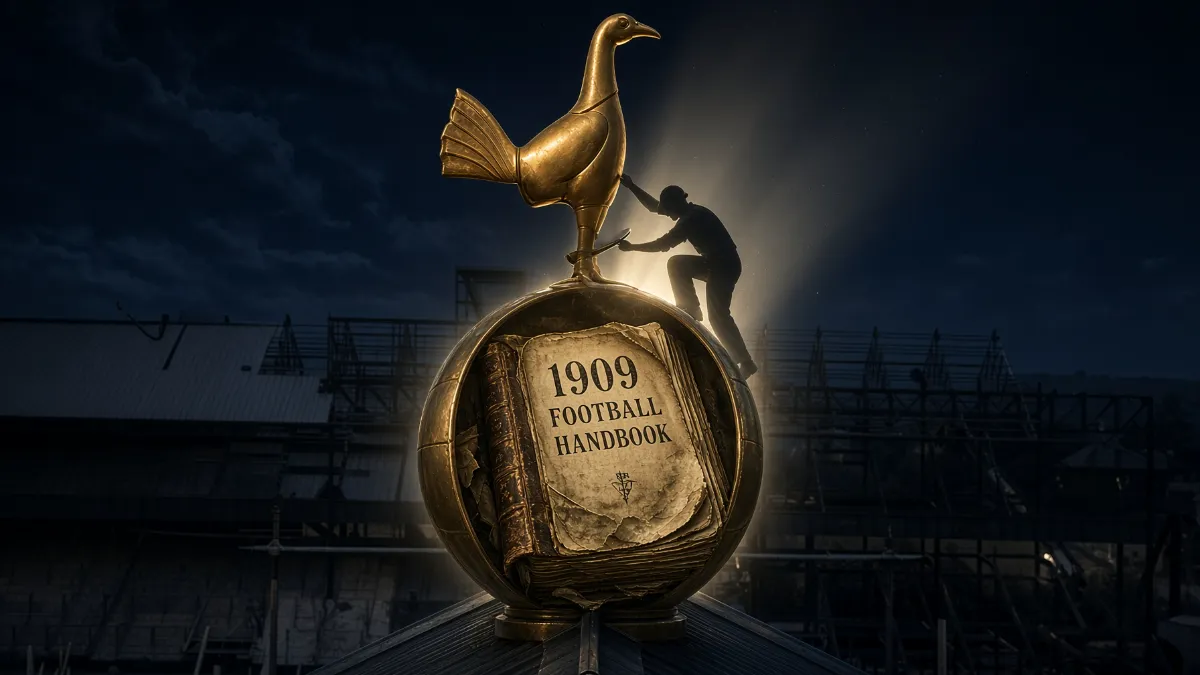
For decades, a legendary tale surrounded the enormous cockerel perched atop White Hart Lane, claiming treasures lay hidden within its body. Remarkably, one individual believed it wholeheartedly, attempting to claim the purported riches for himself.
The most amusing detail came to light later. When the cockerel was finally removed and opened, it concealed no coins or jewels. Instead, they found a thoroughly soaked old club handbook.
This famous cockerel first appeared at White Hart Lane back in 1909. Crafted by William James Scott, a former player for Tottenham during their amateur days, the structure was truly an imposing sight.
Standing atop a football, the copper cockerel reached a height of nearly three metres and was placed on the gable of the west stand. Over the years, it became one of the stadium's most iconic symbols. However, it was the stories surrounding it that truly captured the imagination.
Rumours swirled throughout London, suggesting that the metal ball under the cockerel wasn't empty, but instead held old coins—or, in more extravagant claims, genuine gold.
While it’s impossible to pinpoint the origin of these whispers, what is certain is that the legend resonated with many, casting a spell on at least one brave soul who decided to investigate the truth for himself.
According to club historian John Fennelly, someone scaled the roof in the 1950s, seeking to reach the cockerel in hopes of finding the supposed gold. Unfortunately, this treasure hunt didn't last long; the intruder was apprehended.
Yet, the legend endured, evolving into the perfect football yarn. A colossal metal bird sits atop a stadium, purportedly guarding a fortune within its belly—while a daring soul attempts to liberate it. The club, however, only entertained the notion many decades later.
In the 1980s, the then-chairman of Tottenham, Irving Scholar, grew curious about what lay inside the storied structure. The cockerel was removed, and the football opened to reveal the hidden contents.
What did onlookers expect? A treasure? In reality, there was nothing of value—just a solitary item: an old club handbook from the 1909/10 season. The decades had not been kind, with water having seeped into the chamber, rendering the book utterly drenched.
One can only imagine the disappointment of the man who risked life and limb climbing the roof for the promise of hidden wealth, ending up with nothing but a soggy handbook.
The cockerel has had quite the life itself. It was taken down during roof repairs in 1934, removed again in 1957 due to new lighting being installed, and reappeared above the east stand just a year later. The original structure was finally retired in 1989 because of its condition, only to be replaced by replicas, though the club preserved the original.
When they built the new stadium, a larger golden cockerel returned, almost double the size of its predecessor. Remarkably, designers retained even the minor imperfections of the original sculpture.
Thus, this footballing emblem has survived the old stadium, several renovations, and a treasure hunt that yielded nothing of worth—save for a club handbook that surely cost far less than the effort needed to retrieve it.