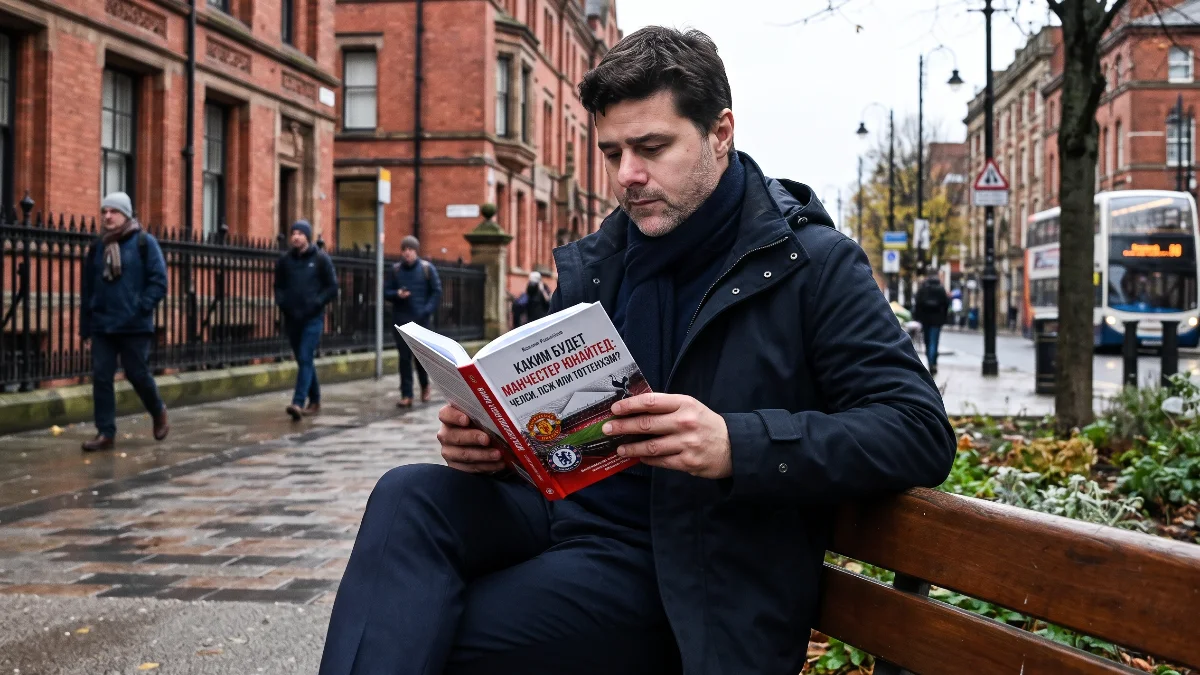
Manchester United face a difficult question: what kind of football should Mauricio Pochettino implement if he takes charge? His previous experience at Tottenham, Paris Saint-Germain and Chelsea offers several points of reference, but none of those models can simply be transplanted to Old Trafford.
Manchester United need Tottenham's collective principles, the tactical flexibility of Pochettino's late-season Chelsea and an understanding of the mistakes made at PSG. Combining those elements could help the Argentinian build a team suited to the players available.
Pochettino's previous projects were not three entirely different expressions of his coaching philosophy. Each time, he tried to adapt his preferences to the squad, expectations and constraints of the club in question.
Manchester United have several squad considerations to take into account. Carlos Baleba added much-needed athleticism in midfield but has suffered an injury. Youri Tielemans looks more comfortable creating from a higher position than defending large spaces. Kobbie Mainoo offers a different way of progressing the ball.
Bruno Fernandes, Matheus Cunha, Bryan Mbeumo and Amad Diallo also give the manager several options for setting up the attack.
The main question is not which player will become the new Harry Kane, Christian Eriksen or Cole Palmer. Pochettino needs to find ways for his players to work together without forcing comparisons between them.
Tottenham: the key legacy is collective movement
The most familiar image of Pochettino's Tottenham is a young, energetic side who press aggressively, attack through central areas and use overlapping full-backs. But that description does not capture every aspect of the team.
At their peak in 2016/17, Tottenham could play in a 4-2-3-1 or with three centre-backs in a 3-4-2-1. Eric Dier played an important role in adapting between those structures.
Kyle Walker and Danny Rose provided width, Christian Eriksen and Dele Alli operated closer to the centre and Harry Kane remained the main focal point in attack. Mousa Dembele and Victor Wanyama provided a combination of ball progression and physical power in midfield.
Tottenham finished second in the Premier League that season with 86 points.
The team's success was about more than high intensity. Players' movements allowed their team-mates to act more boldly. A full-back could push forward because another player covered the space left behind. Eriksen moved infield because a team-mate maintained the width. Alli could run beyond Kane knowing there was a player nearby capable of linking the move.
Even switching to three centre-backs did not mean abandoning the central idea. The distribution of responsibilities changed. Wing-backs played higher, centre-backs helped progress the ball and Eriksen could drop closer to midfield to provide an extra passing option.
That is the Pochettino legacy that could benefit Manchester United: a flexible structure in which each player's movement takes account of the positions of the others.
What Manchester United can take from it
Bruno Fernandes and Matheus Cunha do not need to perform identical creative functions. One can drop to receive the ball while the other threatens the opposition's next defensive line.
Mbeumo can provide depth in attack or move into open channels. Amad, meanwhile, can offer a passing option on the opposite flank.
These are possible combinations, not a confirmed starting line-up. The selection would depend on the players' fitness, the opposition and whether Pochettino wants to use a specialist centre-forward.
The main lesson from Tottenham is that a team can use several players who prefer central areas at the same time. But someone must provide width and someone must make runs behind the defenders.
The system would be less effective if every attacker dropped to receive the ball and the only solution was to ask both full-backs to push forward constantly.
The situation in defence presents another constraint. Luke Shaw is continuing his recovery after another spell out. Baleba's injury also limits the team's ability to cover central areas if the full-backs play an active part in attacks.
Pochettino should therefore adopt the underlying mechanism rather than try to recreate his old Tottenham side. For example, one full-back could push forward while the other stays in a more cautious position. That looks more sensible than trying to find a new Walker and Rose immediately.
PSG: a warning about misallocated responsibilities
Pochettino's time in Paris is often described simply: too many stars, not enough pressing and a manager who failed to bring the players together. There were indeed problems with the distribution of defensive work, but reducing his entire spell to that assessment would be wrong.
In February 2022, PSG beat Real Madrid 1-0. The match showed that Pochettino could organise a strong collective performance around outstanding attacking players.
Lionel Messi dropped closer to midfield, Marco Verratti linked the lines and Kylian Mbappe threatened the space behind the defence. Danilo Pereira helped maintain midfield balance while the full-backs provided width.
The press worked too. The wide forwards moved infield to put pressure on Real's centre-backs and goalkeeper. Messi adjusted his position to help the team create a numerical advantage in central areas.
This was not simply a team waiting for Mbappe to save them through individual brilliance.
The second leg, however, was more revealing. PSG led 2-0 on aggregate, but Karim Benzema's hat-trick gave Real a 3-1 win and sent them through to the next round 3-2 on aggregate.
A mistake playing out led to the first goal. After that, PSG could not regain control when the course of the match changed.
One tie cannot explain Pochettino's entire tenure. But those two matches show the difference between a structure that works when the initial plan succeeds and a team capable of adjusting after a setback.
What Manchester United need to avoid
Manchester United cannot afford a situation in which the attackers have complete freedom and the midfield is left to fix every problem behind them on its own.
That does not mean Fernandes, Cunha and Mbeumo must all do the same defensive work. Different positions have different responsibilities. What matters is that those responsibilities are connected.
If the centre-forward starts to press a defender, the attacking midfielder must know which pass into a central area to block. If a winger moves out to press the opposition full-back, the midfielder behind must account for the space left open.
If the first line of the press is bypassed, the whole team must understand how to recover defensively.
The main danger is an attractive first line of pressure completely detached from the second. Tielemans cannot be selected for his passing and then judged as though his main task is to cover vast spaces on his own.
Baleba's return will add physical power, but one player's recovery will not solve the problem of a constantly stretched structure.
PSG also offer a positive lesson: star players do not need to be turned into identical footballers to create a team. They need a system that accounts for their differences without allowing those differences to excuse a lack of collective work.
Chelsea: the best tactical changes came late in the season
Pochettino's season at Chelsea is difficult to assess conclusively. Chelsea finished sixth, winning their final five league matches in a row. They also faced a large number of injuries and had the youngest average starting line-up in the league.
At the same time, Chelsea conceded 63 Premier League goals while scoring 77.
There are two possible interpretations: a promising young project that was not given enough time, or an expensive team who took too long to become cohesive. For Manchester United, the more important question is what changed in Chelsea's play.
Towards the end of the season, Marc Cucurella began moving from left-back into central midfield. That gave Chelsea an extra link between the lines.
Combined with the work of Moises Caicedo and Conor Gallagher, the change helped improve the structure around the attacking group.
A 2-2 draw with Aston Villa began a run in which Chelsea then beat Tottenham 2-0 and West Ham 5-0.
The change was important because it redistributed responsibility between the players. Pochettino did not simply ask his midfielders to control more space. He added another player alongside them who could help progress the ball and changed the routes of attack.
What Manchester United can take from it
The lesson is not that Diogo Dalot or Noussair Mazraoui must immediately become the new Cucurella.
An inverted full-back is a solution to a particular tactical problem, not an obligatory feature of modern football.
Pochettino first needs to establish exactly what Manchester United lack in possession.
Do they need a player alongside the defensive midfielder? Are they missing an extra passing option out wide? Do they need cover behind a defender who pushes forward? Or do they need someone capable of making runs beyond the first line of the press?
Only then should he decide whether moving a defender infield would help.
Manchester United already have several midfielders who want to be involved in the first passes and link the lines. Adding another player to the same area could make it harder to progress the ball if nobody is then able to occupy the space left vacant.
The main lesson from Chelsea, then, is to redistribute responsibilities before blaming individual players for failing to perform impossible tasks.
One successful tactical change late in the season does not, however, erase the defensive problems that existed before it.
Midfield is the main area for tactical comparisons
Tottenham's Dembele-Wanyama partnership cannot be recreated simply by labelling Mainoo a ball progressor and Baleba a physically powerful midfielder.
Similar individual qualities do not necessarily mean the same game intelligence, experience or understanding.
Mainoo's role needs to be defined with his ability to receive the ball and link play in mind. He also needs suitable support for the next phase of a move.
Once he returns, Baleba can add physical power and ball-winning ability. But his first appearances for Manchester United also showed a need for greater composure.
Tielemans can help progress the ball and create chances from a higher position. But for that to work, the team cannot constantly leave him alone to defend large spaces.
A successful midfield must distribute responsibilities between its players rather than demand that each become an all-rounder before the team can function.
Bruno Fernandes presents a separate challenge.
Using him higher up keeps him closer to the opposition goal. But that requires a reliable partner to provide the link between the lines.
Dropping the Portuguese midfielder deeper would give the team more options to progress the ball, but remove a potential attacking contributor from the final third.
Pochettino should not try to solve the problem by allowing Fernandes to switch freely between the two roles without control. Freedom must be accompanied by compensating movements from team-mates: someone must occupy the space he leaves, someone must remain available further forward and someone must provide cover if possession is lost.
That is much closer to Tottenham's best principles than an artificial attempt to make Fernandes the new Eriksen.
The centre-forward needs a role, not a famous predecessor to copy
Benjamin Sesko's injury complicates Pochettino's immediate selection. Joshua Zirkzee offers a different way of combining with team-mates, while Mbeumo could also be considered at centre-forward.
None of them, however, needs to become the new Harry Kane.
If Mbeumo plays up front, Manchester United could emphasise his runs into open channels and support for combinations from midfield.
If Zirkzee drops to receive the ball, the other attackers must make runs beyond him.
After Sesko returns, Pochettino can assess how his presence changes the positioning of players in the penalty area and the team's options for playing out under pressure.
The main mistake would be to select a striker for one quality and then build the team's play around a completely different function.
A forward who can make runs but is left isolated under a constant stream of high balls is not being given a suitable role. A striker capable of linking play, but without team-mates making runs beyond him, will not automatically make the attack more cohesive either.
Pochettino's previous teams offered different solutions to that problem. Now Manchester United's players must determine which one suits them best.
Pressing must be a collective agreement
Pochettino's Tottenham are often remembered as an example of how much more intensely a team can play after the Argentinian manager's arrival.
But a willingness to work harder is not enough on its own.
Effective pressing requires direction, a trigger to start the pressure and a plan for recovering defensively. The team must understand which pass they want to provoke, who will press the next receiver and when the defensive line should push up to support the press.
Until those movements are coordinated, selective pressure from a compact block may be more effective than trying to press high constantly.
That would not mean Pochettino abandoning his philosophy. Rather, it recognises that a playing identity cannot be established simply by increasing the number of individual runs.
PSG's first match against Real in 2022 is a good example of coordinated pressure. Chelsea's season, meanwhile, is a reminder that a productive attack does not in itself guarantee defensive control.
Which version of Pochettino should Manchester United choose?
The Argentinian's experience at the three clubs offers different lessons for Manchester United.
Tottenham should be the long-term reference point. Collective movement, a clear distribution of responsibilities and the opportunity for players to develop within a shared structure are the principles that need to be brought to Manchester.
Chelsea should be an example of tactical flexibility. Pochettino needs to be ready to change the structure if the initial distribution of responsibilities is not working. Late improvements should not, however, excuse waiting too long to address obvious problems.
PSG should be a warning. Having plenty of talented players does not guarantee that a team will operate as a unit. At the same time, the Paris spell showed that Pochettino can organise play of far greater complexity and quality than the eventual Champions League disappointment might suggest.
Manchester United are not choosing between three different managers. The club need to give one experienced coach a clear task and the right conditions to carry it out.
Pochettino must work with the squad he has, not memories of his best players from the past.
The right version of the Argentinian for Manchester United is not an unchanged version from Tottenham, PSG or Chelsea. It is a manager who understands which elements of each of those three projects genuinely suit the current team.