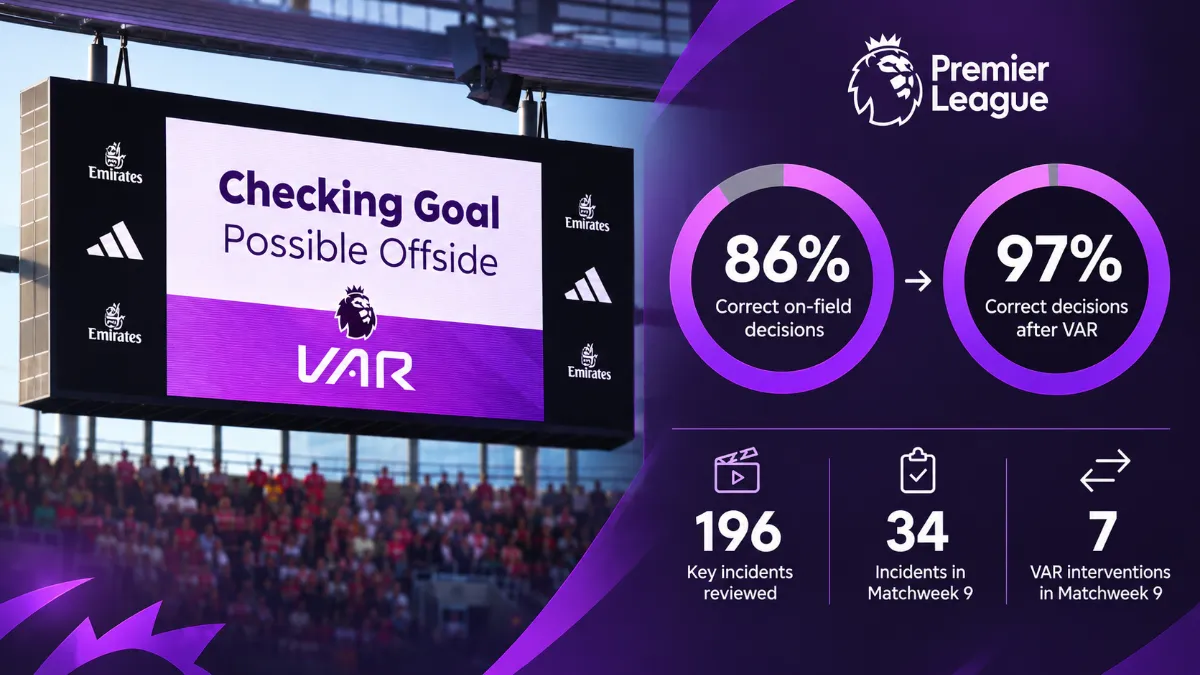
Premier League referees made the correct initial decision in 86% of 196 key incidents across the first nine rounds of the 2026/27 season, according to figures published by the league. After VAR interventions, the proportion rose to 97%, although the system did not eliminate every error.
The figures follow the work of a panel that analyses disputed refereeing decisions in Premier League matches. This season, the results of its reviews have begun appearing regularly on the league's official website.
How often do referees get decisions wrong?
The panel examined 196 key incidents from the start of the 2026/27 season.
It judged that referees made the correct on-field decision in 86% of cases.
That means approximately one in seven of the incidents reviewed was judged incorrectly.
There is an important distinction, however: the figures do not cover every decision referees make during matches.
The review includes only the most significant incidents — goals, penalties, red cards and other moments that could have a major impact on a match's result.
It would therefore be wrong to say that referees get 14% of all their decisions wrong.
After VAR, the proportion of correct final decisions reached 97%.
That is a difference of 11 percentage points.
According to the panel's assessment, that is how much the accuracy of refereeing decisions improved through the use of video replays.
The ninth round proved particularly difficult
The results from the ninth round were particularly notable.
The panel reviewed 34 key incidents and found that only 76% of the referees' initial decisions were correct.
In other words, almost a quarter of the most important incidents were judged incorrectly.
VAR changed the referees' initial decisions seven times, and the panel deemed all seven interventions justified.
On-field referees therefore made errors considerably more often in that round than the season average, but the video assistants successfully corrected a series of wrong decisions.
Nevertheless, some disputed incidents did not receive the necessary intervention.
Even with multiple cameras and the ability to review an incident, error-free refereeing is not guaranteed.
Why doesn't VAR correct every mistake?
A key feature of the system is that the video assistant cannot intervene in every disputed incident.
For a review to take place, the referee's error must be clear and obvious.
The panel therefore assesses two questions separately: whether the referee made the correct initial decision and whether there were sufficient grounds for VAR to intervene.
Sometimes the experts find that a referee's decision was wrong but also conclude that the video assistant was right not to recommend a review.
That is because of the high threshold for intervention.
If an incident allows for several reasonable interpretations, the system should not automatically replace the referee's decision.
That is why some errors remain uncorrected even after video checks.
Who assesses the referees?
The assessment is carried out by a five-person panel.
Three members are former players or coaches. The Premier League and refereeing organisation Pro Ref each have one representative.
The panel has existed since the 2022/23 season, but its results have begun to be published weekly in the current campaign.
The experts watch recordings of key incidents and vote on whether the referee's initial decision was correct.
If a majority considers it wrong, a further assessment is made of whether VAR should have intervened.
This approach allows on-field refereeing and the actions of video assistants to be analysed separately.
Even an obvious handball requires a review
One illustrative incident in the ninth round occurred in Aston Villa's match against Fulham.
In the 12th minute, the ball struck midfielder Sander Berge's raised arm.
The referee initially did not award a penalty, but the decision was changed after VAR intervened.
All five panel members agreed that a penalty should have been awarded.
The experts explained that the player's arm was in an unjustifiably high position and made his body bigger.
In the first nine rounds, referees did not award a single penalty for handball on the field. Two such penalties were awarded after VAR interventions.
The figures reflect referees' caution when assessing such incidents.
Is 97% enough for perfect refereeing?
On the one hand, the data supports the value of video replays: the proportion of correct decisions increases significantly.
On the other, even after VAR intervention, around 3% of key incidents still receive an incorrect final decision.
In matches where a single penalty or disallowed goal can decide the destination of three points, even that small proportion of errors matters.
The overall statistics also do not show how serious the consequences of each decision were for a particular team.
The 97% figure offers a measure of the system's overall effectiveness, but it does not mean individual matches were free of controversial incidents.
Publishing the panel's findings makes these shortcomings more visible while also helping to distinguish genuinely wrong decisions from incidents where supporters simply disagree with the interpretation of the rules.