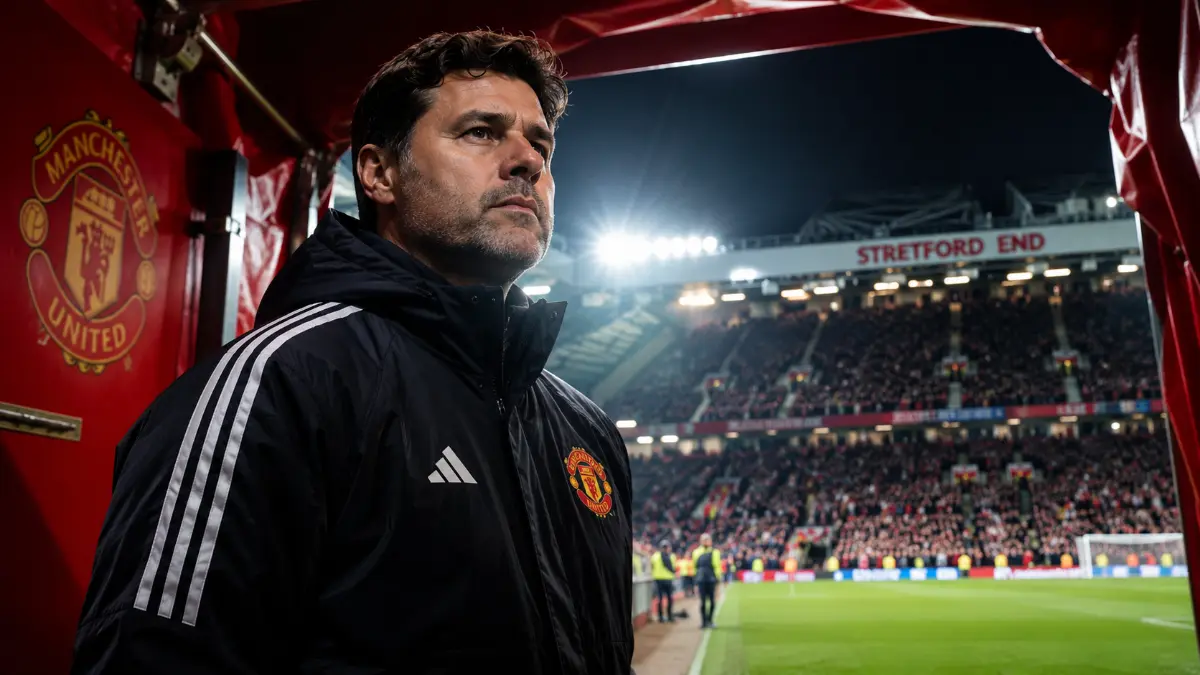
Mauricio Pochettino's appointment as Manchester United head coach could prove a serious test for the Argentine. The Telegraph columnist Oliver Brown believes he risks facing not only the team's sporting problems but also restrictions imposed by the club's leadership.
In his column, Brown likened Pochettino's move to Old Trafford to entering a circus, from which the coach could be fired like a human cannonball. The central question is whether the Argentine will receive the authority and financial resources needed to rebuild the team.
Pochettino's reputation is no guarantee of success
Pochettino has earned a reputation as a coach who favours intense, high-pressing football and works extensively with young players.
One of the Argentine's main achievements remains taking Tottenham to the Champions League final. He oversaw significant progress at the club despite relatively limited opportunities in the transfer market.
Brown points out, however, that in 15 years as a coach Pochettino has won only three domestic trophies in France, all with a Paris Saint-Germain side that had considerable financial resources.
According to Brown, Pochettino has developed a strong media image, but must now prove that his coaching abilities can change the situation during one of the most troubled periods in Manchester United's modern history.
Conflict with the leadership could be the biggest problem
The column pays particular attention to the relationship between the coach and the club's leadership.
Previous manager Ruben Amorim openly expressed dissatisfaction with the restrictions on his work. The Portuguese said he had joined Manchester United as a manager, not just a coach, emphasising his desire to have his own influence over sporting decisions.
Brown notes that Amorim was forced to abandon his preferred system of three centre-backs after discussions with Jason Wilcox.
Pochettino must now build relationships with Sir Jim Ratcliffe, chief executive Omar Berrada and sporting director Jason Wilcox.
Brown doubts the Argentine will readily accept restrictions on transfer policy. If Pochettino demands reinforcements in January and the leadership say the necessary funds are unavailable, serious tension could arise between the parties.
Defence needs an urgent rebuild
Brown considers the state of Manchester United's defence one of their main problems.
As an example, he points to the defenders who finished the team's final match under Michael Carrick against Aston Villa: Patrick Dorgu, Noussair Mazraoui, Leny Yoro and Ayden Heaven.
In Brown's view, that defensive line raises questions about the club's ambitions and their fight to climb out of the lower half of the table.
Former Manchester United player Gary Neville has also urged Pochettino to secure guarantees that two defenders will be signed in the next transfer window before finalising all the terms of his appointment.
Pochettino will need to improve the team's fitness
Another important task will be raising the intensity of the team's play.
Pochettino is known for his demanding standards of fitness, intense pressing and constant movement off the ball.
However, Brown believes the current Manchester United squad may not be fully ready for such an approach.
The Argentine is unlikely to significantly lower his demands for players who do not fit his vision of modern football. That could make major personnel changes necessary in the coming months.
From the United States to Manchester United
Pochettino is leaving the United States national team for one of European football's leading coaching jobs. His time with the US was marked by difficult circumstances, including the controversy over Donald Trump's intervention in the situation surrounding Folarin Balogun's red card at the World Cup.
Despite the pressure, the Argentine maintained his reputation and received a new four-year contract with the United States.
Managing a national team and taking charge of Manchester United are very different tasks, however. Pochettino will have to prepare his team almost immediately for serious Premier League tests, including a meeting with Liverpool at Anfield.
Brown acknowledges that, in more favourable circumstances, Pochettino could be the ideal coach to build a new project. However, he doubts that Manchester United's leadership will give him the freedom he needs.
The main danger is that the new coach's ambitions could clash with the club's management model. If the parties cannot find common ground, Pochettino risks sharing the fate of several previous Manchester United managers.