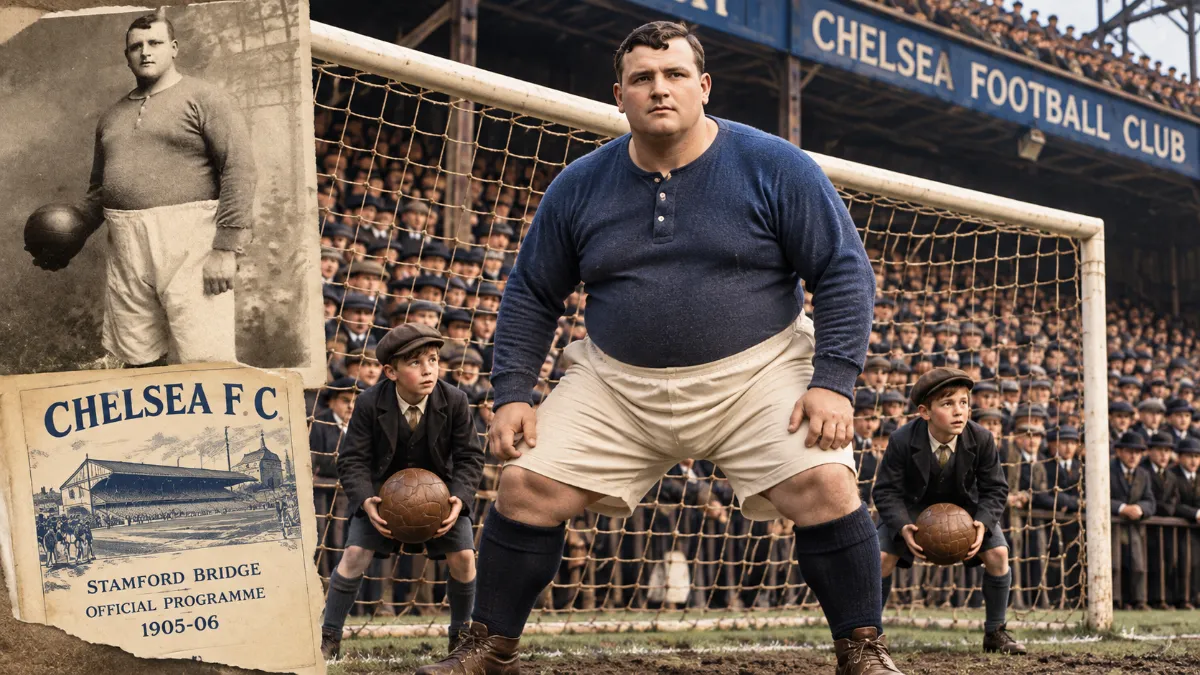
William 'Fatty' Foulke, Chelsea's first goalkeeper, weighed around 140 kg and was one of the club's first stars. According to legend, two boys were placed behind the goal just for him—thus the first ball boys came to be. Yet, there's a crucial caveat to this beautiful story.
In the summer of 1905, the newly formed Chelsea Football Club needed a figure who would immediately entice fans to buy tickets.
They found the perfect fit.
William Foulke.
Height—about 188 cm.
Weight during his time with Chelsea—around 140 kg.
Position—goalkeeper.
Nickname—'Fatty.'
Football marketing a century ago was quite the spectacle.
He was enormous, even by today’s standards.
For modern football, 188 cm is fairly standard for a goalkeeper.
But back in the early 20th century, the average Brit was considerably shorter.
Most of the players next to Foulke weighed half as much.
In team photographs from that era, you didn't have to look too hard to spot him.
He simply took up an unusually large portion of the frame.
However, picturing Foulke as a circus performer plonked in goal wouldn’t do him justice.
He was a proper athlete.
Prior to Chelsea, he had enjoyed a successful stint with Sheffield United, winning the English championship and two FA Cups, besides even earning an England cap.
And for a man of his size, he was surprisingly agile.
Chelsea quickly realised: this was no ordinary goalkeeper
The club was fresh on the scene.
There was a need for fans, attention, and big names.
Foulke fit the bill perfectly.
He was appointed captain of Chelsea’s first team, and the towering goalkeeper quickly became one of the main attractions of the fledgling club.
People flocked to see him play.
In their debut season, Chelsea drew a staggering crowd—around 68,000—against Manchester United.
And here comes one of the best legends from early English football.
Two boys were placed behind the goal
According to club lore, Foulke had no need to chase every ball that sailed past him.
Thus, Chelsea decided to position two boys behind him to return the balls to the pitch.
Essentially, they took on the role of modern ball boys.
However, the ploy was supposedly even cleverer.
Two small children beside the colossal Foulke gave the impression of making him look even bigger.
Picture a forward from 1905.
Standing in front of you is a man weighing 140 kg.
And flanking him are two little boys.
The goal suddenly appears much smaller.
Chelsea claims that this is how the first ball boys came to be.
A magnificent story. But there’s one problem
We wish we could say that Chelsea invented the ball boy concept in 1905 because of their giant goalkeeper.
But this is where fact starts to blur with pub legend.
Stories about Foulke have been embellished over decades.
Supposedly, he ate eleven breakfasts.
Rumour has it that he once burst into the changing room naked in a bid to confront an official.
Allegedly, the famed chant 'Who Ate All the Pies?' first emerged regarding him.
And apparently, he was the reason ball boys came into existence.
The issue lies in the fact that confirming many of these tales over a century later is nearly impossible. Research into his biography warns that much of the famed folklore surrounding Foulke was likely embellished later on.
But the boys behind Chelsea's goal really did become part of history
So, the most honest version goes like this:
Chelsea does indeed have a longstanding club narrative that in 1905, two boys were placed behind Foulke for ball retrieval and added visual effect.
However, to claim that this is when ball boys were definitively invented on the globe is a bold statement.
And that doesn’t diminish the story.
On the contrary.
It’s an ideal football legend from the early 20th century.
A towering captain.
Two small boys.
And a forward gazing at the goal, thinking:
'Where do I even aim to shoot here?'
Foulke himself lasted just one season
What’s particularly amusing is that one of Chelsea’s first cult figures spent only a short time at the club.
After the 1905/06 season, he moved on.
Next was Bradford City, and then the end of his playing days.
But within just a year, Foulke had given the new club an identity.
An identity so striking that even 120 years later, it’s hard not to spot him in a photograph.