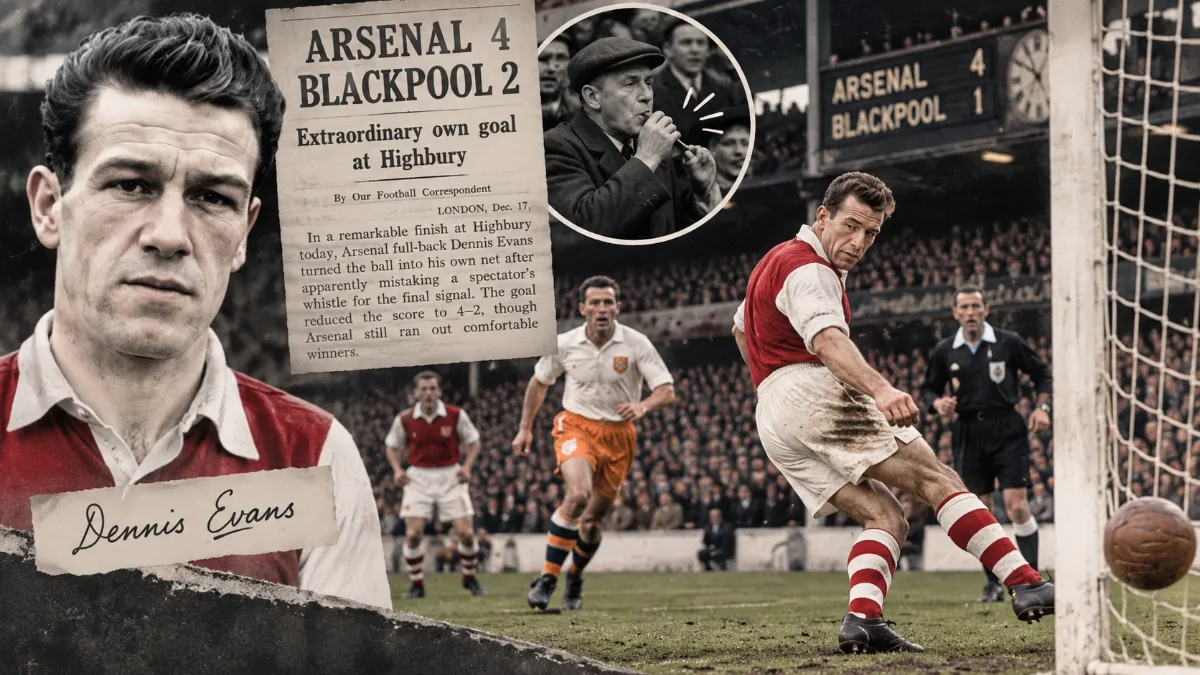
In December 1955, Arsenal defender Dennis Evans heard a whistle from the stands and thought the match had ended. He turned around and put the ball into his own net, with the referee not stopping play — much to the dismay of the Gunners, who were then obliged to concede the goal to Blackpool.
A fan's whistle — Arsenal defender scores an Own Goal
At that moment, Arsenal were cruising with a 4-1 lead, and only minutes remained on the clock.
Upon hearing the whistle, Evans spun around and, perhaps thinking to make a dramatic finish, sent the ball into his own net.
It wasn't until the referee pointed to the centre circle that he realised his mistake.
The date was December 17, 1955, and Arsenal were hosting Blackpool at Highbury.
Back then, the visitors featured one of the game's greats, Stanley Matthews, who was a handful for any defender. Evans had the task of containing him that day.
With Arsenal comfortably in control, the final outcome seemed all but decided with the score at 4-1 as the clock ticked down.
However, Evans, assuming the game was over, received the ball near his own goal.
A loud whistle rang out from the stands, convincing Evans that the match was finished.
In a moment of confusion, he decided to elegantly wind up the match by shooting into his own net.
The ball found the back of the net, and in what must have been a surreal instant, he expected his teammates to celebrate and then make a beeline for the dressing room.
Instead, the referee's signal confirmed that it indeed counted as a goal.
It turned out that the whistle wasn't from the referee; it was from a spectator merely enjoying the moment.
The game continued without interruption.
In terms of regulations, there were no disputes; the referee had not called for play to stop.
The ball was still in play, and Evans had deliberately redirected it into his own goal. Thus, Blackpool had scored, reducing the score to 4-2.
Fortunately for Evans, this incident did not affect the final result.
Arsenal held on to win the match, and the bizarre goal turned into one of the legendary anecdotes of old Highbury.
With today's football technology, such a situation seems almost unfathomable.
Players now have electronic scoreboards, officials are in constant communication via headsets, and stadiums are decked out with an overwhelming amount of visual information.
During the mid-1950s, the game was much simpler.
If someone in the stands could mimic a referee's whistle effectively, the ramifications could be quite real.
Dennis Evans found this out in the most unfortunate way possible.
There was no pressing from an opponent.
He didn't lose his footing or misplace a pass.
The ball didn't deflect off him.
The defender merely heard the signal, assumed work was done, and inadvertently scored one of the most straightforward own goals in football history.
This remains, without a doubt, one of the most comical own goals ever.