Football is war,
— Rinus Michels
With just a couple of months to go until the eagerly anticipated World Cup kicks off in the USA, Canada, and Mexico, the spectre of geopolitical unrest looms large. Recent tensions surrounding Iran have intensified a global dialogue, casting a pall over the sport's biggest stage. The absence of an Iranian delegation at a crucial organisational meeting in Atlanta has sparked contentious remarks from US President Donald Trump, who has raised safety concerns about the participation of Iranian players and fans. Speculation is rife in the halls of power that FIFA might consider redistributing matches favouring Canada and Mexico, but the clock is ticking on such drastic measures.
The upcoming tournament may carry the most ominous political undertones seen in recent decades. Indeed, the history of the World Cup has never been confined to mere athletic competition. Since the 1930s, the tournament has served as a grand political stage, where the most explosive clashes often emerge not just as sporting rivalries but also as contests over state interests and national ideologies.
The French thaw of 1998: white roses instead of ultimatums
The ongoing crisis between the USA and Iran is far from unprecedented. The severing of diplomatic ties trace back to the Islamic Revolution of 1979, leaving a legacy of mutual mistrust. This tension hung heavily over the group stage match at the 1998 World Cup in France, where the teams met for the first time since diplomatic relations were cut. An atmosphere charged by years of hostilities preceded the kick-off.
Yet the Iranian players made history with a symbolic gesture of goodwill, presenting their opponents with white roses before the first whistle, a powerful token of peace. The match itself ended with Iran winning 2-1, a result that was celebrated back home as a triumph of national pride on a global stage. That evening illustrated football's unique potential to temporarily soften the fiercest of political divisions.
The grim thirties: Mussolini's propaganda and the disgraceful salute on Berlin's pitch
The 1930s marked a particularly sinister chapter in the competition's history, as Europe was engulfed by a wave of fascism. Dictator Benito Mussolini was quick to recognize the game’s vast potential as a tool of state propaganda. The 1934 World Cup hosted in Italy was choreographed to showcase the regime's dominance and national superiority.
A politically charged semi-final between Italy and Austria stood out, with the famed ‘Wunderteam’ symbolizing democracy's alternative to fascism. Italy won a closely contested match accompanied by whispers of pressure on referees and intimidation of Austrian players. While hard evidence of manipulation never surfaced, the psychological tension was palpable, with Mussolini himself interceding behind the scenes. Italy followed this with a victory over Czechoslovakia in the final, which the fascist media portrayed as evidence of racial and national superiority.
Four years later, with the world on the brink of chaos, the English Football Association boycotted the World Cup. Yet on May 14, 1938, the England team, under orders, raised their arms in salute to the Nazi regime during a friendly in Berlin. These troubling gestures had occurred previously against Italy, but were justified by the diplomatic climate of the time. In hindsight, however, the event stands as one of the darkest stains on the history of English sport.
Defending champion Italy entered the tournament just after the Anschluss, the forced annexation of Austria. They triumphed over Hungary with a score of 4-2, reinforcing fascist regimes, which were brazenly paving the way toward World War II.
The 'Miracle of Bern' 1954: catalyst for the Hungarian storm
Following the hiatus of the war, the tournament resumed in 1950 in Brazil. The 1954 edition in Switzerland soon reflected the geopolitical divides of the time, as postwar Germany was split between the West and East. The Hungarian team, known as the 'Mighty Magyars', under the guidance of Ferenc Puskas, were the heavy favourites, boasting a staggering record leading up to the final.
With only one defeat between 1950 and 1956 — a stunning loss in the final against West Germany, who pulled off a remarkable comeback to win 3-2 — this match, immortalised as the 'Miracle of Bern', had far-reaching consequences: for West Germany, it was a moment of national renewal, linking success with the capitalist bloc during the early Cold War. For Hungary, it ignited widespread dissent against the ruling government, eventually leading to the uprising in 1956.
The 'Football War' of 1969: when sport became a detonator
Moving into the late 1960s, the stage of sports-political madness shifted to Latin America. In June 1969, the World Cup qualifiers between Honduras and El Salvador escalated into actual military conflict, famously dubbed the 'Football War'.
The teams exchanged home victories, with the ultimate showdown rescheduled for June 27, 1969, at a neutral venue in Mexico City’s Estadio Azteca. All three matches were marred by brutal fan violence, necessitating the mobilization of over 1700 Mexican police for the deciding fixture. El Salvador emerged victorious 3-2 in extra time, securing their first-ever World Cup spot, just weeks before warfare broke out between the two nations.
The roots of the strife lay in longstanding grievances: land reform issues, illegal migration, and territorial claims that had seen thousands of Salvadorans deported from Honduras. Media in both countries stoked tensions with inflammatory coverage. Shortly after the final whistle, gunfire erupted at the border, culminating in bombings and land invasions within weeks.
The four-day conflict tragically claimed thousands of lives and displaced countless others. Decades later, Mauricio Rodriguez, the man whose winning goal ignited this tumult, remarked:
Outside, my goal was seen as the one that started the war. But in reality, the war would have erupted regardless — with or without that goal.
1974: spy games in Hamburg and shadows of occupation in Munich
The West Germany World Cup in 1974 symbolized the nation’s return to the fold of civilised nations, yet reminders of the past loomed large. The group stage match between the two Germanys became an iconic encounter of the Cold War.
In a stunning upset, East Germany defeated their western counterparts 1-0, a victory that was exploited by the socialist camp for propaganda purposes. Strategically, this benefitted West Germany, who cruised through to the final against the Netherlands. With the scars of Nazi occupation still fresh for the Dutch, this match was heavy with historical significance.
The encounter between Johan Cruyff's free-spirited 'Total Football' and Franz Beckenbauer's pragmatic strategy had profound psychological implications. After conceding a quick penalty, West Germany rallied to win 2-1, raising a new World Cup trophy. Despite their formal alliance, the wounds of occupation remained raw, a reality seen later in the Euro ’88 semi-final.
Blood on the bar: Argentina's junta in 1978
The 1978 World Cup, held in Argentina, unfolded against the backdrop of a brutal military dictatorship led by General Jorge Rafael Videla. During a period known as the 'Dirty War', the regime enforced a ruthless crackdown, disappearing thousands of political dissidents. As writer Riz Richards aptly noted, this tournament could be dubbed 'Blood on the Bar'.
For Argentina to reach the final, they needed to beat Peru with an improbable margin of four goals, which they astonishingly achieved, winning 6-0 before overpowering the Netherlands in the final 3-1.
Suspicions of conspiracies surrounding the Peruvian side quickly arose, and although no legal proof was produced, the match became emblematic of how dictatorial regimes employ international platforms for self-justification. Captain Daniel Passarella's triumphal lifting of the trophy stood in stark contrast to the horrific repression occurring behind closed doors.
The Falklands, Ardiles' repentance, and Maradona's reckoning in Mexico
Amidst economic turmoil, the junta sought tactics to divert public attention. The regime, now under General Leopoldo Galtieri, set its sights on the Falkland Islands, a British territory. They miscalculated, launching a military invasion on April 2, 1982, that resulted in a 74-day war. Prime Minister Margaret Thatcher dispatched a naval fleet, and by June 14, Argentina surrendered, suffering 649 military casualties against 255 British.
This defeat marked the end of the dictatorship and a return to democracy in Argentina, while British conservatives won a landslide victory in the general elections. The war shattered the lives of legendary footballers Ossie Ardiles and Ricardo Villa, who had captured the hearts of Spurs fans after winning the FA Cup in 1981. Ardiles, affected by the war’s toll, referred to the conflict as madness before temporarily moving to Paris Saint-Germain, facing backlash upon his return to Argentina.
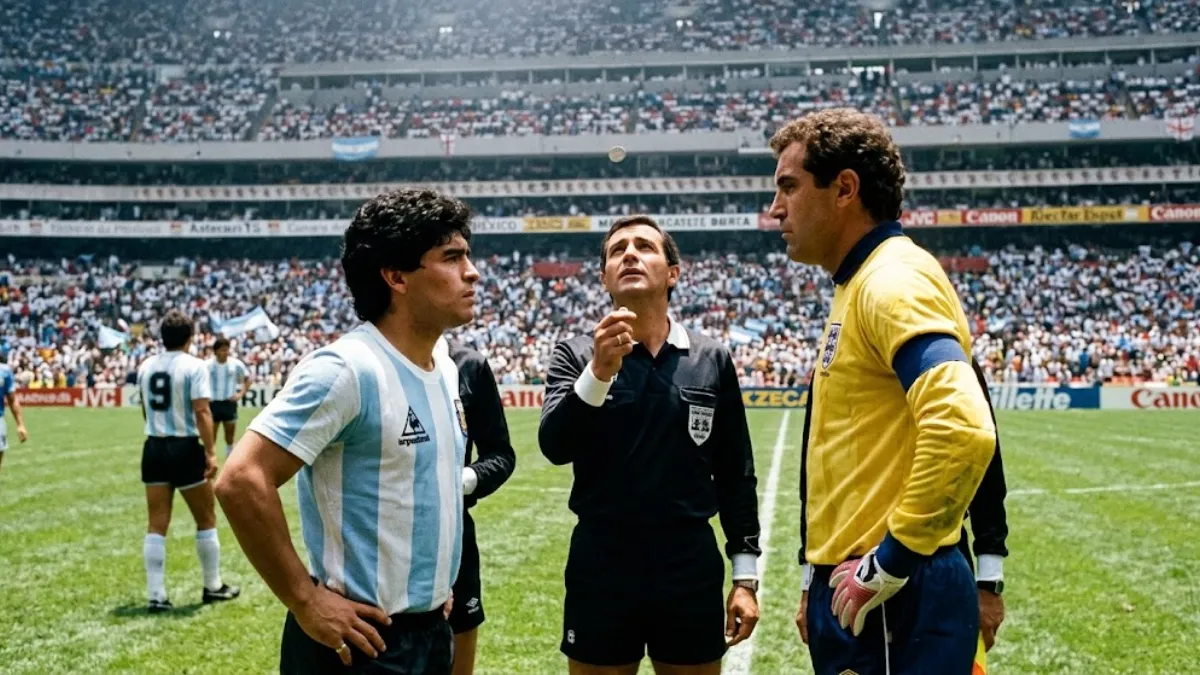
The climax came during the 1986 World Cup in Mexico, when Argentina faced England just four years post-conflict. The trauma of war lingered heavily across Argentine households.
On that sweltering day at Estadio Azteca, Diego Maradona netted two of the most famous goals in history: one infamously scored with his hand, and the other a dazzling solo effort dubbed 'The Goal of the Century'. His line about the goals being 'partly the head of Maradona, partly the hand of God' became legendary. The victory for Argentina, marked by a 2-1 scoreline, was celebrated as a divine retribution, transforming Maradona into a national deity.
While World Cups do not incite wars themselves, they do serve as monumental lenses, amplifying underlying geopolitical conflicts. Football matches become platforms where historical grievances find a symbolic expression, intertwined with national flags and anthems, reminding us that the beautiful game remains enmeshed within the weave of global politics.
