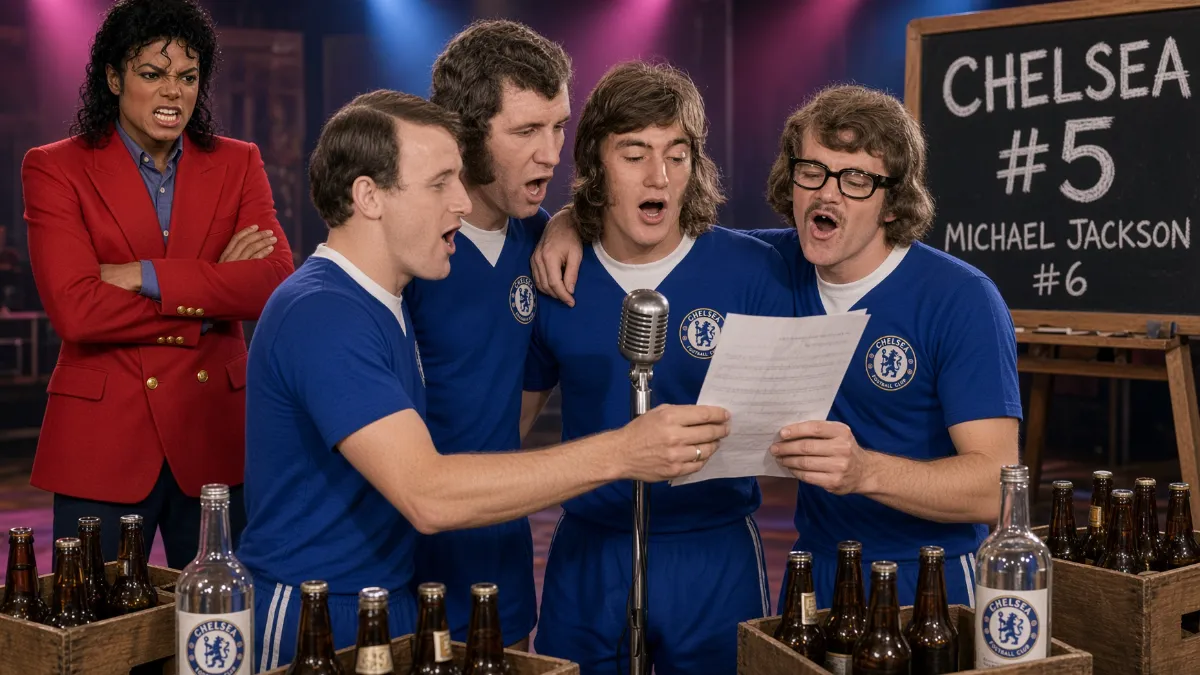
In 1972, Chelsea players recorded Blue Is the Colour ahead of the League Cup final. Crates of beer and vodka were brought to the studio, and soon the band found themselves on Top of the Pops while the song soared to fifth place in the UK charts, remaining popular for over fifty years.
It was February 1972 when Chelsea’s squad made their way into a recording studio. Some of the players remembered the lyrics, while others were less prepared. For a sense of confidence, approximately ten crates of lager and a couple of cases of vodka made their way into the mix.
Weeks later, the team found themselves at number five in the British chart, ahead of Michael Jackson, Paul Simon, and Slade. The song they recorded, initially as a bit of a joke, is still sung at Stamford Bridge today.
This iconic piece was called Blue Is the Colour.
A song was needed, but not typical football rubbish
The journey began with the League Cup final of 1972. Dave Sexton’s Chelsea was enjoying one of the most vibrant periods in their early history: they had clinched the FA Cup in 1970, the European Cup Winners' Cup in 1971, and defeated Real Madrid and Manchester City in Europe. Next up was Stoke City at Wembley.
At the time, releasing records for major football tournaments was all the rage. England’s national team reached number one with Back Home before the 1970 World Cup, and Arsenal released their version of Rule Britannia, landing at 16th place ahead of the 1971 FA Cup final.
However, Chelsea aimed to stand out.
Based on King’s Road in fashionable West London, with its boutiques, musicians, long hair, and undeniable swagger, the club needed something atypical — far from the usual football choir.
Music producer and Chelsea fan Larry Page took charge of the task. The song was penned by Daniel Boone and Rod McQueen, while Page infused it with that distinctive football spirit. The amusing dilemma was that the writers knew next to nothing about football.
So Page created a cheat sheet on the key elements: The Shed, the Bridge, the club's iconic blue colour, and the atmosphere of matches, which embodied Chelsea at that time. They incorporated brass instruments and a marching rhythm to ensure that the entire stand could join in.
It boiled down to a simple message:
Blue is the colour, football is the game…
And that was all it took.
Ten crates of lager and footballers at the mic
The real fun began when the players arrived at the studio in Islington.
Beforehand, they were handed cassettes to help them learn the lyrics. According to Larry Page's recollections, some players prepared, while others couldn’t have cared less.
Paddy Mulligan, a participant in that recording, recalled:
We definitely weren’t singers – Shirley Bassey and Tom Jones had nothing to worry about.
In the studio, they jested with one another, debating who sang the worst, all while attempting to create a makeshift musical group from a football locker room. Tommy Baldwin later reminisced that they brought along around ten crates of lager and a couple of crates of vodka, as the microphone inspired more fear than a crucial match.
Teetotaler Mulligan remarked that alcohol helped with bravery rather than vocal performance.
Sound engineers had to work their magic on the rest.
They didn’t just record one song; they made a whole album
Here’s where the story becomes even more captivating.
Blue Is the Colour was just one of ten tracks the Chelsea squad recorded during that session, resulting in a full LP.
Peter Osgood took the mic for Chirpy Chirpy Cheep Cheep, while David Webb seized his chance for solo parts, getting so into character that nobody dared stop him. Page reminisced about Webb singing Alouette while the rest were in fits of laughter in the control room.
The album didn’t rewrite musical history.
But one song, against all odds, took off.
Higher than Michael Jackson
Blue Is the Colour was released on the Penny Farthing label on 18 February 1972. It entered the British charts at number 15, climbed to number nine, and then hit the fifth position from 5 to 11 March, remaining in the rankings for a total of 12 weeks.
Looking back, the top ten line-up certainly raises a smile.
At number one was Harry Nilsson with Without You, followed closely by Don McLean’s American Pie.
Fifth was Chelsea Football Club.
Number six? Michael Jackson with Got to Be There.
So in March 1972, you could stroll into a British record shop and genuinely discover that Peter Osgood, Ron Harris, and the gang were outselling Michael Jackson.
The music press was equally startled. Record Mirror noted the song’s unexpected success, highlighting it as a hit that transcended local acclaim in West London and resonated nationwide. Larry Page even jested that European audiences might mistakenly think Chelsea was the name of a new band.
And then the call came from Top of the Pops
Reaching fifth place meant the joke had officially spiralled out of control.
The footballers were invited onto Top of the Pops, the country’s top music television show at the time.
On the BBC, the squad turned up pretty much as you’d expect a bunch of footballers in 1972: some in leather jackets, others in their usual attire. The producer took one look at them and decided a pop group shouldn’t dress like that.
Someone had to make a quick dash to Marks & Spencer to buy 14 identical jumpers. John Dempsey, years later, couldn’t recall their colour but assumed they were blue.
As for the alcohol, by all accounts, everything was very much under control that day. Paddy Mulligan recalled that some of his teammates were downing drinks at an impressive speed before shooting. Larry Page later described trying to manage the unruly footballers on Top of the Pops as a complete nightmare.
And all of this was broadcast on national television.
They lost the cup, but the song remained
This tale carries a delightful irony for football fans.
The record was recorded specifically for the League Cup final.
Yet Chelsea ultimately lost the final.
On 4 March 1972, Stoke City defeated the Londoners at Wembley, 2-1. Peter Osgood equalized just before half-time, before George Eastham scored the winning goal for Stoke.
The cup returned to Stoke-on-Trent.
But the song? That stayed in London.
In fact, it has now outlasted nearly everyone involved in that recording.
Blue Is the Colour still echoes around Stamford Bridge over fifty years later. It has been covered and reinterpreted far beyond the club’s walls, with versions emerging even from the Vancouver Whitecaps and the Australian cricket team. Larry Page recounted hearing the song at weddings and funerals of former players.
Perhaps that’s why it survived.
The players weren’t trying to craft a grand anthem; sixteen footballers simply showed up at the studio, cracked open some beer, mangled a simple tune, and then continued on with their footy careers.
Ironically, the trophy for 1972 eluded Chelsea, yet they inadvertently laid down an anthem for the next fifty years.